Thursday, December 26, 2013

Ok, our Christmas wasn't like this

Umm...Cat, What Are You Doing Here... 

I hope ya'll have a good Christmas. Ours was pretty darn good. The turkey dinner went well (turkey needed salt), Steve's mom  got to our house with perfect timing and she liked her gift and we spent the rest of the day relaxing. Steve, I think, liked the Law & Order DVDs. I went to bed early because I felt like I was fighting off something and was really really tired.

One funny thing: it's been warm-ish and the snow is melting but our driveway and the streets in our subdivision are sheets of ice. Steve's mom's car was parked in driveway ... and slid several feet down it by the time she left. 

We have a lot of turkey left over so I think tonight I'll make turkey pot pie for dinner and turkey chili verdi (for me for the weekend).

I don't think there's anything on TV tonight so I'm hoping to read since I didn't do very much yesterday.

Fingers crossed that Dad's gift shows up today so I can deliver presents.

And this was me with my Kindle(s):

Creatures Great and Small Wait for Santa

I've found some games I can play on my Kindle Fire now. Yes, they are time sucks but I don't care. Bwa hahaha!

Much love,
PK the Bookeemonster

Current Events - December 26, 2013

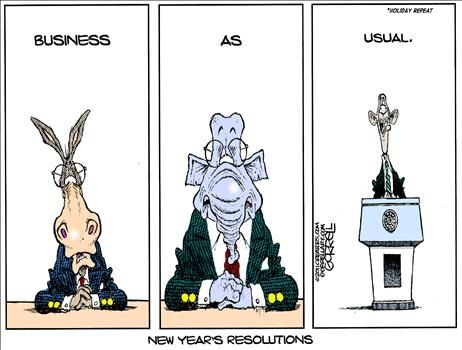
Political Cartoons by Bob Gorrell

Postal rates going up

Mailing a letter is about to get a little more expensive.
Regulators on Tuesday approved a temporary price hike of 3 cents for a first-class stamp, bringing the charge to 49 cents a letter in an effort to help the Postal Service recover from severe mail decreases brought on after the 2008 economic downturn.
Many consumers won’t feel the price increase immediately. Forever stamps, good for first-class postage whatever the rate, can be purchased at the lower price until the new rate is effective Jan. 26.
The higher rate will last no more than two years, allowing the Postal Service to recoup $2.8 billion in losses. By a 2-1 vote, the independent Postal Regulatory Commission rejected a request to make the price hike permanent. (PK'S NOTE: Riiiiight)
The higher cost “will last just long enough to recover the loss,” Commission Chairman Ruth Y. Goldway said.
Bulk mail, periodicals and package service rates rise 6 percent, which is likely to draw significant consternation from the mail industry.

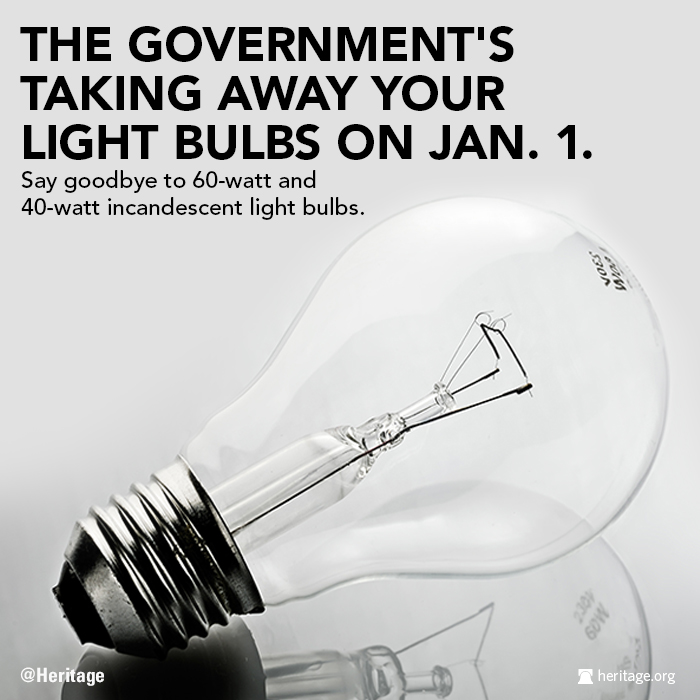
Time to Stock Up on Incandescent Bulbs Before They Go Out Permanently

If your New Year’s resolution is to change your light bulbs, don’t worry—the federal government’s here to help.
Beginning January 1, 2014, the federal government will ban the use of 60-watt and 40-watt incandescent light bulbs. The light bulb has become a symbol in the fight for consumer freedom and against unnecessary governmental interference into the lives of the American people.
 

MB12.26_v2 - light bulbs

In 2007, Congress passed and President George W. Bush signed into law an energy bill that placed stringent efficiency requirements on ordinary incandescent bulbs in an attempt to have them completely eliminated by 2014. The law phased out 100-watt and 75-watt incandescent bulbs last year.
Proponents of government-imposed efficiency standards and regulations will say, “So what? There are still plenty of lighting options on the shelves at Home Depot; we’re saving families money; and we’re reducing harmful climate change emissions.”
The “so what” is that the federal government is taking decisions out of the hands of families and businesses, destroying jobs, and restricting consumer choice in the market. We all have a wide variety of preferences regarding light bulbs. It is not the role of the federal government to override those preferences with what it believes is in our best interest.
Families understand how energy costs impact their lives and make decisions accordingly. Energy efficiency has improved dramatically over the past six decades—long before any national energy efficiency mandates.
If families and firms are not buying the most energy-efficient appliance or technology, it is not that they are acting irrationally; they simply have budget constraints or other preferences such as comfort, convenience, and product quality. A family may know that buying an energy-efficient product will save them money in the long term, but they have to prioritize their short-term expenses. Those families operating from paycheck to paycheck may want to opt for a cheaper light bulb and more food instead of a more expensive light bulb and less food.
Some may read this and think: Chill out—it’s just a light bulb. But it’s not just a light bulb. Take a look at the Department of Energy’s Federal Energy Management Program. Basically anything that uses electricity or water in your home or business is subject to an efficiency regulation.
When the market drives energy efficiency, it saves consumers money. The more the federal government takes away decisions that are better left to businesses and families, the worse off we’re going to be.

What to Do When ObamaCare Unravels


Health insurance should be individual, portable across jobs, states and providers, and lifelong and renewable.

.By John H Cochrane
.....The U.S. health-care market is dysfunctional. Obscure prices and $500 Band-Aids are legendary. The reason is simple: Health care and health insurance are strongly protected from competition. There are explicit barriers to entry, for example the laws in many states that require a "certificate of need" before one can build a new hospital. Regulatory compliance costs, approvals, nonprofit status, restrictions on foreign doctors and nurses, limits on medical residencies, and many more barriers keep prices up and competitors out. Hospitals whose main clients are uncompetitive insurers and the government cannot innovate and provide efficient cash service.

We need to permit the Southwest Airlines, LUV -0.48% Wal-Mart, WMT +0.35% Amazon.com AMZN +0.41% and Apples of the world to bring to health care the same dramatic improvements in price, quality, variety, technology and efficiency that they brought to air travel, retail and electronics. We'll know we are there when prices are on hospital websites, cash customers get discounts, and new hospitals and insurers swamp your inbox with attractive offers and great service.

The Affordable Care Act bets instead that more regulation, price controls, effectiveness panels, and "accountable care" organizations will force efficiency, innovation, quality and service from the top down. Has this ever worked? Did we get smartphones by government pressure on the 1960s AT&T T +0.04% phone monopoly? Did effectiveness panels force United Airlines and American Airlines to cut costs, and push TWA and Pan Am out of business? Did the post office invent FedEx, FDX +0.68% UPS and email? How about public schools or the last 20 or more health-care "cost control" ideas?

Only deregulation can unleash competition. And only disruptive competition, where new businesses drive out old ones, will bring efficiency, lower costs and innovation.

Health insurance should be individual, portable across jobs, states and providers; lifelong and guaranteed-renewable, meaning you have the right to continue with no unexpected increase in premiums if you get sick. Insurance should protect wealth against large, unforeseen, necessary expenses, rather than be a wildly inefficient payment plan for routine expenses.

People want to buy this insurance, and companies want to sell it. It would be far cheaper, and would solve the pre-existing conditions problem. We do not have such health insurance only because it was regulated out of existence. Businesses cannot establish or contribute to portable individual policies, or employees would have to pay taxes. So businesses only offer group plans. Knowing they will abandon individual insurance when they get a job, and without cross-state portability, there is little reason for young people to invest in lifelong, portable health insurance. Mandated coverage, pressure against full risk rating, and a dysfunctional cash market did the rest.

Rather than a mandate for employer-based groups, we should transition to fully individual-based health insurance. Allow national individual insurance offered and sold to anyone, anywhere, without the tangled mess of state mandates and regulations. Allow employers to contribute to individual insurance at least on an even basis with group plans. Current group plans can convert to individual plans, at once or as people leave. Since all members in a group convert, there is no adverse selection of sicker people.

ObamaCare defenders say we must suffer the dysfunction and patch the law, because there is no alternative. They are wrong. On Nov. 2, for example, New York Times NYT +0.96% columnist Nicholas Kristof wrote movingly about his friend who lost employer-based insurance and died of colon cancer. Mr. Kristof concluded, "This is why we need Obamacare." No, this is why we need individual, portable, guaranteed-renewable, inexpensive, catastrophic-coverage insurance.

On Nov. 15, MIT's Jonathan Gruber, an ObamaCare architect, argued on Realclearpolitics that "we currently have a highly discriminatory system where if you're sick, if you've been sick or you're going to get sick, you cannot get health insurance." We do. He concluded that the Affordable Care Act is "the only way to end that discriminatory system." It is not.

On Dec. 3, President Obama himself said that "the only alternative that Obamacare's critics have, is, well, let's just go back to the status quo." Not so.

What about the homeless guy who has a heart attack? Yes, there must be private and government-provided charity care for the very poor. What if people don't get enough checkups? Send them vouchers. To solve these problems we do not need a federal takeover of health care and insurance for you, me, and every American.

No other country has a free health market, you may object. The rest of the world is closer to single payer, and spends less.

Sure. We can have a single government-run airline too. We can ban FedEx and UPS, and have a single-payer post office. We can have government-run telephones and TV. Thirty years ago every other country had all of these, and worthies said that markets couldn't work for travel, package delivery, the "natural monopoly" of telephones and TV. Until we tried it. That the rest of the world spends less just shows how dysfunctional our current system is, not how a free market would work.

While economically straightforward, liberalization is always politically hard. Innovation and cost reduction require new businesses to displace familiar, well-connected incumbents. Protected businesses spawn "good jobs" for protected workers, dues for their unions, easy lives for their managers, political support for their regulators and politicians, and cushy jobs for health-policy wonks. Protection from competition allows private insurance to cross-subsidize Medicare, Medicaid, and emergency rooms.

But it can happen. The first step is, the American public must understand that there is an alternative. Stand up and demand it.

Why All Children Should Learn to Work

Jack Kingston’s “no free lunch” suggestion doesn’t go far enough

 By Jillian Kay Melchior
Georgia Representative Jack Kingston came under fire last week for suggesting that schoolchildren who receive free lunches “pay a dime, pay a nickel . . . or maybe sweep the floor of the cafeteria,” an effort he suggested would help get “the myth out of their head that there is such a thing as a free lunch.” The proposal has immediately drawn comparisons to Newt Gingrich’s suggestion in 2011 that poor schools fire union janitors and instead hire needy kids who want to earn an extra buck.
The uproar has been swift and emotional, with critics claiming that Kingston, like Gingrich before him, is a mean old bully, exacerbating the already awful lives of poor kids.
“Have you ever seen what children are like?” wrote Jim Newell at Salon. “God, they’re awful. The well-off ones would dump their whole lunch trays on the floor and say to the poor kid, ‘Hey, Rags, clean ’er up, because ha ha ha, your parents have a low income.’ Not only would you be scarring poor kids for life; you’d also give a whole new generation of non-poor kids ample practice time to develop into [a**holes].” Josh Israel at ThinkProgress complained that Kingston’s proposal would incite truly needy children to turn down the lunch being offered to them, for fear of being singled out. And The Root’s Keli Goff wrote that Kingston should do “something substantive to help these children break the cycle of poverty so they don’t have to listen to you threatening to use their kids for slave labor a generation from now.”
But the real problem with Kingston’s proposal is that it doesn’t go far enough. Children — regardless of whether or not they receive a free or reduced lunch — would benefit from chipping in with school cleaning. Moreover, society would benefit.
I know that from my own experience. I spent most of my elementary years at Noah Webster Christian School in Cheyenne, Wyo. A tiny school, it operated out of churches on a shoestring budget. Dads chipped in one summer and built a playground for us. The education was excellent, but a janitorial staff was far beyond reach, so we children were expected to pitch in.
In true Mary Poppins spirit, teachers often made a game of it: Shaving cream removes ink smudges from desks mid-semester, and for some reason, it’s much more fun to speed-scribble multiplication tables in the mousse-y mess than it is to write them in a notebook. But fun wasn’t guaranteed, and chores came as regularly as homework. On Fridays, children vacuumed and wiped down the chalkboards. And on one of the last days of each semester, we spent the day deep-cleaning — trotting around with plastic buckets, scrubbing floor trim and washing the white-brick walls of the hallway.
As much as I complained at the time, that responsibility taught us to value public property. It also gave us a stake in our school. We worked hard to keep it clean and functioning, and that taught us to appreciate the resources we had. The experience also gave us practical competencies far beyond what home-ec classes offer. Finally, it was strangely empowering: We were trusted to mix Pine-Sol with water (albeit with supervision), and our teachers understood that just because we weren’t yet twelve didn’t mean we were idiots incapable of climbing a ladder to dust without falling to our untimely demise.
The values of class-chore time were lost on me, of course — until I transferred to public school in fifth grade. Children made messes with reckless abandon. It didn’t matter if you left a trail of crumbs behind you in the cafeteria or if you tracked in mud from recess; you wouldn’t be the one cleaning it up. In contrast, in third grade at Noah, I once spent a recess scrubbing out my desk after I’d forgotten an apple in it over break. It had molded and liquefied, and it smelled terrible. It was my fault, and because it was my problem to deal with, I was more responsible in the future.
But that ethic runs contrary to the progressive mindset, which infantilizes adults — and children, much more so. The Root’s Goff continued her critique of Kingston’s proposal by suggesting more handouts for poor kids, including “comprehensive sexual education, low-cost contraception and loan-free financial college aid so these kids can have a real chance to compete.” And then she let slip the underlying theory:
The words “personal responsibility” should almost always be limited to adults, and to those teens nearing adulthood who have the capacity to make informed decisions, good and bad, and to be held accountable for them accordingly.
That’s a radical perspective. Education has, historically, been a moral endeavor as much as a practical one. Not only does it equip our young to someday gainfully provide for themselves and their families; it also prepares children to gradually assume responsibility. Good education leads to self-government, and the education that separates learning from responsibility does children no favors. So by all means, pass the mop to all children, rich or poor.

Wednesday, December 25, 2013

Well.... yeah.

Partners in Christmas Crime

Santa's Fed Ex delivery helpers didn't come to my house in time with Dad's Christmas present. At all. So I guess I'm hoping it will come tomorrow. Dammit. I ordered it on December 12th. According to the tracking info, CafePress didn't even start to ship it until December 17th (5 days wasted).  And then it hung out in Denver from the 19th until the 23rd (5 days wasted). I emailed them to share my displeasure.

I'll be putting the turkey in the roaster in about a half hour. I'm planning for dinner between 12 and 1. Steve will go pick up his mom around noon-ish.

I had set my alarm for after 7 this morning to walk the dogs so there would be at least some daylight. They woke me up at 6:40 all raring to go.

After dinner and Steve's mom goes home, I am envisioning a nap, reading, maybe a movie ... just relaxing. Steve's present from me this year was six seasons of Law and Order on DVD. There was a time when that show was on virtually 24/7 but not anymore and Steve mentioned something about not being to find it anymore a while ago. I started with Season Three, when Jerry Orbach joined the cast, we both like him best. 

I'm currently reading on Kindle, A PALE HORSE by Charles Todd. This is 10th of 16 in series featuring Ian Rutledge, a shell-shocked World War I veteran returning to his job at Scotland Yard, in London. Here is a description:
In the ruins of Yorkshire's Fountains Abbey lies the body of a man wrapped in a cloak, the face covered by a gas mask. Next to him is a book on alchemy, which belongs to the schoolmaster, a conscientious objector in the Great War. Who is this man, and is the investigation into his death being manipulated by a thirst for revenge? Meanwhile, the British War Office is searching for a missing man of their own, someone whose war work was so secret that even Rutledge isn't told his real name or what he did. The search takes Rutledge to Berkshire, where cottages once built to house lepers stand in the shadow of a great white horse cut into the chalk hillside. The current inhabitants of the cottages are outcasts, too, hiding from their own pasts. Who among them is telling the truth about their neighbors and who is twisting it? Here is a puzzle requiring all of Rutledge's daring and skill, for there are layers of lies and deception, while a ruthless killer is determined to hold on to freedom at any cost. And the pale horse looming overhead serves as a reminder that death is never finished with anyone, least of all the men who fought in the trenches of France.
It was published in 2007 and has 388 pages. This is a digital loan from the library. 

Merry Christmas, everyone, I hope you are able to spend it happily either with friends, family, or if by yourself that you do something special for yourself.

Much love,
PK the Bookeemonster

Current Events - December 25, 2013

A Christmas musical treat

Yo-Yo Ma and Alison Krauss perform The Wexford Carol, one of the oldest Christmas carols in the Western tradition, dating from the 12th century, with its origins in County Wexford, Ireland.

Kwanzaa: The Holiday Brought To You By the FBI

Bu Ann Coulter
...It is a fact that Kwanzaa was invented in 1966 by a black radical FBI stooge, Ron Karenga -- aka Dr. Maulana Karenga -- founder of United Slaves, a violent nationalist rival to the Black Panthers. He was also a dupe of the FBI.
...It's as if David Duke invented a holiday called "Anglika," which he based on the philosophy of Mein Kampf -- and clueless public school teachers began celebrating the made-up, racist holiday.
...Karenga's invented holiday is a nutty blend of schmaltzy '60s rhetoric, black racism and Marxism. The seven principles of Kwanzaa are the very same seven principles of the Symbionese Liberation Army, another innovation of the Worst Generation.
...Kwanzaa praises collectivism in every possible area of life -- economics, work, personality, even litter removal. ("Kuumba: Everyone should strive to improve the community and make it more beautiful.") It takes a village to raise a police snitch. When Karenga was asked to distinguish Kawaida, the philosophy underlying Kwanzaa, from "classical Marxism," he essentially said that, under Kawaida, we also hate whites.

Cruciphobia at Mt. Soledad: The Cross the Left Can't Bear

 By Michelle Malkin
Consider this: Taylor Swift wasn't even born yet when the fight over the Mount Soledad cross began. How much longer will it drag on? Disgruntled atheists first filed suit over the memorial at a veterans park in San Diego in the summer of 1989. The fringe grievance-mongers have clung bitterly to their litigious activities for nearly a quarter-century. It's time to let go and bring peace to the city.
The historic 43-foot cross has stood atop Mount Soledad on public land since 1954. The Mount Soledad Memorial Association erected the monument to commemorate the sacrifice of American soldiers who died in the Korean War, World War I and World War II. The cross has long carried meaning for the city's residents far beyond religious symbolism. "It's a symbol of coming of age and of remembrance," Pastor Mark Slomka of the Mount Soledad Presbyterian Church said years ago when the case erupted. The San Diego Union-Tribune editorial board explained that the cross is "much like the Mission San Diego de Alcala and the cross at Presidio Park, both of which also are rooted in Christianity but have come to signify the birth of San Diego."
I first started covering the case as an editorial writer at the Los Angeles Daily News in the early 1990s. A federal judge initially ruled that the landmark cross's presence violated the California constitution's church-state separation principles. The city of San Diego put the issue before voters, who overwhelmingly approved a practical solution in 2005: Sell the cross and the park to the veterans group for use in a national war memorial.
A pragmatic, tolerant resolution with 76 percent of voters' support? Heavens, no! The extreme secularists couldn't have that. They sued and sued and sued and sued

Drive Free

By John Stossel
If you saw a fat man in a sleigh distributing presents this week, he was in violation of several government regulations.
The Federal Aviation Administration has complaints about his secret flight path. The Wisconsin Department of Natural Resources might shoot his unauthorized reindeer the way they shot a baby deer named Giggles at an animal shelter this year. His bag of gifts definitely violates numerous charity tax rules. 
...Regulators want their fingers in everything. A new idea gives them an excuse to draw attention to themselves as "consumer protectors." In addition, existing taxi companies request regulation. They want politicians to regulate new competition out of existence.
Luckily, technology and capitalist innovation sometimes move faster than the lazy dinosaur that is government. Lyft, Uber and Sidecar have quickly become popular, and this may help them avoid being crushed. By contrast, politicians don't hesitate to destroy things that people think of as weird or dangerous.


The Santa Race Debate and Misplaced Christmas Priorities

By Bridget Johnson
...It started with culture blogger Aisha Harris’ Dec. 10 op-ed for Slate in which she suggests replacing “a melanin-deficient Santa” with a multicultural representational penguin. Then it escalated when Fox’s Megyn Kelly empaneled three guests on her primetime show to discuss the piece and declared “for all you kids watching at home, Santa just is white.” Both women later said their comments were tongue-in-cheek.
Last week, I was pulled onto NPR, where I’m a regular contributor, to discuss the fracas with Harris and others — the fracas being an argument about the race of a fictional character who lives at the North Pole with elves and pilots a flying-reindeer sleigh to slide down a chimney with presents. Reactions there were varied.
...Isn’t Santa the people who have been quietly stuffing Salvation Army kettles to help them make up for a donation shortfall this year while insisting on remaining anonymous? Isn’t Santa how the town of Havelock, N.C., fed and clothed a 72-year-old Navy veteran who was turned out on the street by his family and helped him get back on his feet? Isn’t Santa the person who quietly buys a cup of coffee for the homeless man on the curb, not because it’s Christmas but because it’s cold?
The outrage in this debate isn’t whether Santa should be portrayed as black, white or Asian, but about how high that debate has climbed on the totem pole of priorities.

Tuesday, December 24, 2013

Merry Christmas Eve


Much love,
PK the Bookeemonster

Current Events - December 24, 2013

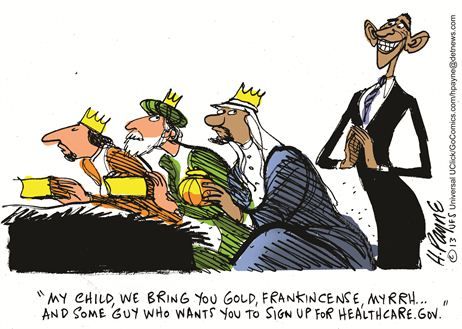
Political Cartoons by Henry Payne 

Government Isn’t Santa

Capitalism is the precondition of generosity.

By Kevin Williamson
....The pope’s argument, fundamentally, is that we can have capitalism on the condition that we feed the poor. This is exactly backward: We can feed the poor if we have capitalism. To give away wealth presumes the existence of that wealth, whether it is an annual tithe or Jesus’ more radical stance of giving away all that one owns. Giving away all that you own does not do the poor an iota of good if you don’t have anything. You can’t spread the wealth without wealth.
Conservatives sometimes protest that the Left presents government as though it were Santa Claus, but Santa Claus, bless him, is a producer. He has a factory up there at the North Pole, full of highly skilled (and possibly undercompensated) labor. He has logistics problems — serious ones. He has production deadlines. The entire point of the Santa Claus myth — at least the animated Christmas-special God Bless America version of that myth — is that those toys aren’t going to make themselves, and they aren’t going to deliver themselves. Government cannot do the work of a captain of industry such as Santa Claus, because government creates nothing. More to the point, government cannot satisfy Jesus’ command that we feed the poor — it produces no food. It has no wealth of its own.
Government isn’t Santa. It’s the Grinch.
Think about it: The redistributionist impulse is driven by envy and bitterness. It is an economic position held, not accidentally, most strongly by people who cringe at the sight of a manger scene — by people who resent and suspect the very word “Christmas.” The redistributors are the people culturally inclined to abolishing Christmas from the public sphere, who will spend the solstice wailing in angst if a public-school choir should so much as hum “Away in a Manger,” never mind singing the verboten words “Little Lord Jesus.” And, in the Grinchiest fashion, they want to take your stuff.
...There is little, if any, virtue in giving gifts to the people we love. Giving gifts to those we love is like giving gifts to ourselves. There is still less virtue in taking what’s under somebody else’s Christmas tree and distributing it to your friends and allies while congratulating yourself on your compassion. To do so is unseemly. Pope Francis is quite right to argue that economic growth alone does not ensure the humane treatment of the poor and the vulnerable — where he is mistaken is that he assumes that there is another side in that argument. Nowhere in the classical liberal tradition, and certainly not in the Anglo-American liberal tradition, has the idea taken root that capitalism is a substitute for generosity. Capitalism is the precondition of generosity. If you want to feed the Lord’s sheep, you must begin by planting the fields.

2017 and the End of Ethics

Will the Obama-era hypocrisy continue when the next president takes office? 

 By Victor Davis Hanson
...The result, in the Age of Obama, is a deeply rooted cynicism that works out something like the following: The president of the United States is now an iconic figure and thus cannot be held to the minimal standards of veracity demanded of other Americans. The press is an advocate of his agenda and picks and chooses which scandals can be half-heartedly pursued without endangering their shared vision.
How could the media possibly repair its sullied reputation without appearing abjectly hypocritical or artificially zealous? How can the next president resist assuming the extra-constitutional prerogatives of the current one?
We have three years before January 2017. If we are to have any credible press left at all, it has just 36 months to rediscover its ethics and professionalism — or more or less forfeit its integrity for a generation. The president too must either start respecting the Constitution or expect that his successors will follow in his footsteps in pressing their agendas by any means necessary — while always citing the Obama example. Will the next president simply drop the employer-mandate portion of Obamacare? And if he did, would the media point out that he was not faithfully executing the laws that had been enacted?
Because we are now right in the middle of this conundrum, Americans often fail to appreciate how low we’ve sunk — and how little time our president and press have to restore the institutions that they have so undermined for such paltry political advantage.

Planned Parenthood Releases 'Twelve Days of Contraception' Christmas Carol

By Dr Susan Berry
Staff members of the Arizona affiliate of Planned Parenthood are celebrating the season by changing the lyrics of the traditional Christmas carol, “The Twelve Days of Christmas,” to accommodate the abortion industry.
Planned Parenthood Arizona says it "wants to wish everyone happy holidays and a wonderful 2014!" They add, "We hope you will enjoy this original song written by staff and performed by volunteers. And, if you want to know more about the different types of birth control mentioned in the song, visit www.ppaz.org."
Introducing "The Twelve Days of Contraception" or, as Planned Parenthood has named it, "The Twelve Days of Christmas (the contraceptive version)," where your true love will bestow upon you a box of Plan B, condoms, Depo-Provera shots, NuvaRings, birth control pills, dental dams, diaphragms, and other contraceptive goodies

The Light of Christmas

Christopher S Brownwell
....You see, kids, if Christmas means something different to everyone, Christmas has no meaning at all.

To Griswold [National Lampoon's Christmas Vacation], the true meaning of Christmas was to bless his family with a pool.  To Frank Shirley, it was to cancel Christmas bonuses and give out one-year subscriptions to the Jelly of the Month Club.  To Margo and Todd, it was to avoid things that are dirty and messy and corny and clichéd.  But these different meanings ultimately clashed.

Post-modernism doesn't believe in a fixed, absolute truth.  Everyone defines his own "truth."  Existentialism is about defining your own meaning of life through your own personal experiences.  Pluralism has devolved into a personal philosophy comfortable with believing in contradictory truth claims.

Despite Griswold's postmodern, pluralistic, existential philosophy, Christmas has a fixed meaning.  The message has been the same for 2,000 years.  That message is that Light has come into the world to make a way for us to escape the darkness.  "The light shines in the darkness, and the darkness has not overcome it" (John 1:5).

Monday, December 23, 2013

Extra cushioning - that's my super power

So That's What the Blubber is For...


I've set aside the Julia Spencer-Fleming for a bit and I'm now reading SHROUD OF DISHONOUR by Maureen Ash. This is 5th of 6 in series featuring Bascot de Marins, a Templar Knight recovering from imprisonment in the holy lands, in the early 1200s, in England. Here is a description:
Templar Bascot de Marins is preparing to rejoin the Holy Wars when he is called upon to investigate a gruesome murder in the Order's own chapel... The shocking discovery of a strangled prostitute in the Templar chapel throws the Order into disarray. Alongside the corpse is a purse containing thirty pence-the same amount of silver Judas received for betraying Christ. Is the murder revenge for a Templar brother's betrayal? Has one of their own broken his vow of chastity? The Order's preceptor turns to Bascot to determine whether an outsider is seeking to dishonour the Templars or a murderer walks among their ranks.

It was published in 2010 and has 272 pages. I've been putting off reading the series since it appeared she stopped writing it but I was in the mood for a medieval. 

Nothing on TV tonight except reruns so maybe I'll read. The pickings are pretty slim on TV but maybe we'll watch a movie sometime in the next few days. Still have Despicable Me 2 on DVD and Wolverine on On Demand to watch. Steve will probably play on his new computer this evening.

I may not get a chance to post the next couple days with Christmas; I'll have to play that by ear. Plus the news for which I get the current events will probably come to a screeching halt as well. We're working tomorrow until at least noon and maybe further into the afternoon if we're busy. Then spending Christmas Eve with M&D and Steve's mom is coming for dinner Christmas Day.

Merry Christmas Eve Eve!

Much love,
PK the Bookeemonster